| |
|
|
A
Brief History of Golf
How the Game Evolved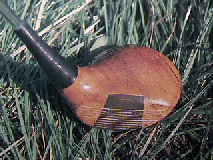
There is general agreement that the Scots were the earliest of golf
addicts but who actually invented the game is open to debate. We know
that golf has existed for at least 500 years because James II of Scotland,
in an Act of Parliament dated March 6, 1457, had golf and football
banned because these sports were interfering too much with archery
practice sorely needed by the loyal defenders of the Scottish realm!
It has been suggested that bored shepherds tending flocks of sheep
near St. Andrews became adept at hitting rounded stones into rabbits
holes with their wooden crooks. And so a legend that persists to this
day was born!
Various forms of games resembling golf were played
as early as the fourteenth century by sportsmen in Holland, Belgium
and France as well as in Scotland. But it was a keen Scottish Baron,
James VI, who brought the game to England when he succeeded to the
English throne in 1603. For many years the game was played on rough
terrain without proper greens, just crude holes cut into the ground
where the surface was reasonably flat!
Early Golf Organizations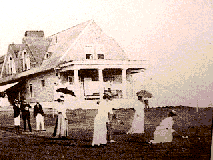
Early golfers played at the game for many years without any thought
of forming a society or club until finally a group of Edinburgh golfers
in 1744 formed a club called the Honourable Company of Edinburgh Golfers.
At this time, the first rules of golf, 13 in all, were drawn up for
an annual competition between sportsmen from any part of Great Britain
and Ireland. A few years later the Society of St. Andrews Golfers
was formed and in 1834, when King William IV became the Society's
patron, the title was changed to the Royal and Ancient Golf Club of
St. Andrews.
The earliest clubs formed outside of Scotland was the Royal Blackheath
Golf Club of England which came into existence in 1766, followed by
the Old Manchester Golf Club founded on the Kersal Moor in 1818. 18th
century golf in the United States, while known to exist, did not catch
on and it was in Canada that golf first established firm roots in
North America. The Royal Montreal Club was formed in 1873, the Quebec
Golf Club in 1875 followed by a golf club at Toronto in 1876. It wasn't
until 1888 that golf resurfaced in the United States. A Scotsman,
John Reid, first built a three hole course in Yonkers, New York near
his home and later that same year formed the St. Andrews Club of Yonkers
on a nearby 30 acre site. From those austere beginnings, golf literally
soared as a new national pastime in the United States. A modern jewel,
Shinnecock Hills, was founded in 1891 on Long Island and by the turn
of the century, more than 1000 golf clubs had opened in North America.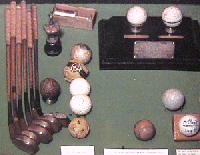
Early
Equipment
The very earliest club makers were thought to be the skilled craftsmen
who produced bows and arrows and other implements of war! The first
authentic record of a club maker was in 1603 when William Mayne was
appointed to the court of James I of England to make golf clubs for
the king and his coherts! Two Scottish club makers are recognized
from the late 1600s, Andrew Dickson of Leith and Henry Mill of St.
Andrews. These clubs featured carved wooden heads of beech, holly,
dogwood, pear or apple and spliced into shafts of ash or hazel to
give the club more whip. Improvements were made by filling the back
of the head with lead and by putting inserts of leather, horn or bone
into the club face. In time, skilled blacksmiths of the day took on
the challenge of forging iron faced clubs, initially without grooves,
to provide more loft for shorter shots. The earliest balls were hand
stitched leather, painstakingly stuffed with boiled feathers! In 1618,
James I of England commissioned James Melvill and an associate to
make feathery balls for the court. It was an exclusive grant for 21
years with the balls stamped by Melvill and any other ball found in
the Kingdom not bearing his trademark were confiscated! You may well
be surprised at the distances achieved by these feathery balls. In
dry weather, a well struck feather ball could travel 180 yards (165
m) but when wet only about 150 yards (135 m). However, the feathery
ball remained king until the middle of the 19th century. In 1848,
a golfing clergyman from St. Andrews, the Reverend Adam Paterson,
experimented with a substance from India called gutta-percha. It had
been sent to him as padding covering a gift and he found that the
material could be softened with heat and then molded into a hard ball.
The gutty as it was known was not an instant success as the smooth
ball tended to duck in flight. Players soon found that its performance
improved at the end of a round when the ball received some nicks and
scratches. Therefore, newly molded balls were scored all over with
a saddler's hammer with such good playing results that the demise
of the feathery was certain.
The gutta-percha
ball lasted for approximately 55 years until succeeded by the Haskell
ball in 1903. An American dentist, Dr. Coburn Haskell, ran some experiments
by tightly wrapping a liquid filled rubber core with strips of elastic
then covering it with a gutta-percha casing. North American golfers
began to take the new ball seriously when Walter Travis, originally
from Australia, won the 1901 United States Amateur Championship using
the Haskell ball. When Alex Herd won the 1902 British Open Championship
again using the Haskell ball, golfers everywhere dropped the gutty
and clamoured for the Haskell! 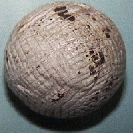
Modern balls have
a more durable cover of balata or surlyn and various solid core balls
with new synthetics have become popular. As well, we have seen the
art of club making go from the original wooden clubs, to forged irons,
then steel shafts and finally all manner of metal heads with many
types of synthetic shafts. Technology has done wonders for the average
golfer but practice, dedication and raw talent still remain a factor
as witnessed by Greg Norman's amazing 63 at Augusta on April 11, 1996,
during the first round of the US Masters Championship.
Golf History FAQ
�
When and where did golf begin?
�
What is the origin of the word "golf"? Does it stand for "gentleman
only, ladies forbidden"?
�
When were the first rules written,
and what were they?
�
Why are golf courses
18 holes in length ?
�
What is the oldest public golf course in the U.S.?
�
What is a Links Course?
�Why
do golfers yell "fore" to warn others of an errant shot?
�How
Did the Word "Mulligan" Acquire Its Golf Meaning?
�How
Did the Word "Dormie" Originate?
�Why
is the golf hole the size that it is?
�When
Was a Tour Event First Televised?
�What
is a stymie?
�My
Ball Struck Overhead Power Lines - Do I Get to Replay the Shot?
�My
Ball is Stuck in a Tree - What are My Options?
Everyone knows golf originated in Scotland, right?
Welllllllll ... yes and no.
It's definitely true that golf as we know it emerged in Scotland.
The Scots were playing golf in its very basic form - take a club,
swing it at a ball, move ball from starting point to finishing hole
in as few strokes as possible - by at least the mid-15th Century.
In fact, the earliest known reference to golf comes from King James
II of Scotland, who, in 1457, issued a ban on the playing of golf
and football (soccer). Those games, James complained, were keeping
his archers from their practice.
James III in 1471 and James IV in 1491 each re-issued the ban on
golf.
But the game continued to develop in Scotland over the decades and
centuries, until 1744 when the first-known rules of golf were put
down in writing in Edinburgh.
Golf Swing Tips
Dramatically Cut Your Golf Handicap Using 4 Simple Moves! Free Download
GolfSwingSecretsRevealed.com
Golf as it was then played would be easily recognized by any modern
golfer.
But can it be said that the Scots "invented" golf? Not quite,
because there's strong evidence that the Scots were influenced themselves
by even earlier versions of games that were similar in nature.
Here's what the USGA Museum says about the issue: "While many
Scots firmly maintain that golf evolved from a family of stick-and-ball
games widely practiced throughout the British Isles during the Middle
Ages, considerable evidence suggests that the game derived from stick-and-ball
games that were played in France, Germany and the Low Countries."
Part of that evidence is the etymology of the word "golf"
itself. "Golf" derives from the Old Scots terms "golve"
or "goff," which themselves evolved from the medieval Dutch
term "kolf."
The medieval Dutch term "kolf" meant "club,"
and the Dutch were playing games (mostly on ice) at least by the 14th
Century in which balls were struck by sticks that were curved at the
bottom until they were moved from Point A to Point B. Sounds a lot
like hockey, doesn't it? Except that it sort of sounds like golf,
too (except for that ice part).
The Dutch and Scots were trading partners, and the fact that the
word "golf" evolved after being transported by the Dutch
to the Scots lends credence to the idea that the game itself may have
been adapted by the Scots from the earlier Dutch game.
Something else that lends credence to that idea: Although the Scots
played their game on parkland (rather than ice), they (or least some
of them) were using balls they acquired in trade from ... Holland.
And the Dutch game wasn't the only similar game of the Middle Ages.
Going back even farther, the Romans brought their own stick-and-ball
game into the British Isles.
So does that mean that the Dutch (or someone else other than that
Scots) invented golf? No, it means that golf grew out of games that
were played in different parts of Europe.
But we're not trying to deny the Scots their place in golf history.
The Scots made a singular improvement to all the games that came before:
They dug a hole in the ground, and made getting the ball into that
hole the object of the game.
As we said at the beginning, for golf as we know it, we definitely
have the Scots to thank.
Did the word "golf" originate as an acronym for "gentlemen only,
ladies forbidden"? That's a common old wives' tale. Or, in this case,
more likely an old husband's tale.
No, "golf" is not an acronym for "gentlemen only, ladies
forbidden." If you've ever heard that, forget it immediately. Better
yet, find the person who told you and let them know it's not true.
Like most modern words, the word "golf" derives from older
languages and dialects. In this case, the languages in question are
medieval Dutch and old Scots.
The medieval Dutch word "kolf" or "kolve" meant "club." It is
believed that word passed to the Scots, whose old Scots dialect
transformed the word into "golve," "gowl" or "gouf."
By the 16th Century, the word "golf" had emerged.
Sources: British Golf Museum, USGA Library
There must have been rules known to golfers dating back to the origins
of the game. Otherwise, how could players have squared off in
competition? What those rules were, nobody knows.
At least not until the mid-18th Century, when the first known
written rules of golf were put into writing by the Gentlemen Golfers
of Leith, now the Honourable Company of Edinburgh Golfers based at
Muirfield. The rules were written for the Annual Challenge for the
Edinburgh Silver Club in 1744.
There were 13 of them, and here they are (with a few explanatory
comments in parentheses). Note how many of these rules survive today:
1. "You must tee your ball within a club's length of the hole." (A
diameter of two club lengths.
Teeing grounds are now defined as two club lengths in depth.)
Like many developments throughout golf history, the standardization of
18 holes did not happen as the result of a momentous decision agreed
upon by many.
And again, like many developments in golf, the standardization of
18 holes can be credited to St. Andrews.
Prior to the mid-1760s - and right up until the early 1900s - it
was common to find golf courses that were comprised of 12 holes, or
19, or 23, or 15, or any other number.
Then, around 1764, St. Andrews converted from 22 holes to 18 holes.
The reason? Well, everyone knows 18 holes are easier to take care of
than 22!
Eighteen holes did not become the standard until the early 1900s,
but from 1764 onward, more courses copied the St. Andrews model. Then,
in 1858, the Royal & Ancient Golf Club of St.
Andrews issued new rules.
I'll let Sam Groves, curator of the British Golf Museum who helped
me with this explanation, take it from here:
"In 1858, the R&A issued new rules for its members; Rule 1 stated
'one round of the Links or 18 holes is reckoned a match unless
otherwise stipulated'. We can only presume that, as many clubs looked
to the R&A for advice, this was slowly adopted throughout Britain. By
the 1870s, therefore, more courses had 18 holes and a round of golf
was being accepted as consisting of 18 holes."
What was the First Public Golf Course in the United States? When Van Cortlandt Golf Course opened in New York City in 1895, it
became the first public golf course in America. There were other golf
courses in the U.S. by that time - perhaps 100 or more - but Van
Cortlandt was the first built for the masses.
And Van Cortlandt Golf Course is still in operation today, the
centerpiece of Van Cortlandt Park in the Bronx. The park also boasts a
lake and two nature trails.
In Van Cortlandt Park you'll also find the Old Croton Aqueduct Trail.
The aqueduct, built during the 1830s and 1840s, was New York City's
first major water supply project.
What is a Links Course?
Especially in the U.S., the term "links" is frequently
misapplied. "Links" refers to a very specific type of course.
But nowadays it is common for any golf course that is
relatively treeless to call itself a links course. And that's
not accurate.
But in America, they get away with it. Most American
golfers - and I am one - have never seen a links course ...
except for the ones we see each year while watching the
British Open.
The British Golf Museum says that "links" are coastal
strips of land between the beaches and the inland agricultural
areas. This term, in its purest sense, applies specifically to
seaside areas in Scotland.
So "links land" is land where seaside transitions into
farmland. Links land has sandy soil, making it unsuited for
crops |
The land, in fact, was thought to be worthless because it was
not arable for crops.
But back in the mists of Scotland, someone got the bright
idea to put a golf course on that land. What else where they
going to do with it? And links golf courses emerged.
Because they were close to the beach, lots of sand traps were
a natural (the soil was very sandy, after all). But the traps
had to be deeply recessed to prevent sand from being blown away
by the constant wind. Because the soil was of a poor quality and
constantly buffeted by the seaside winds, not much would grow on
it - mostly just tall, reedy grasses, and certainly no trees.
So a true links course is not any course that is treeless.
The term "links" historically applies specifically to strips of
land in seaside areas that feature sandy soil, dunes and
undulating topography, and where the land is not conducive to
cultivated vegetation or trees.
Because they were built on narrow strips of land, links
courses often followed an "out and back" routing. The front nine
went out from the clubhouse, one hole stringed after another,
until reaching the 9th green, which was the point on the golf
course farthest from the clubhouse. The golfers would then turn
around on the 10th tee, with the back nine holes leading
straight back to the clubhouse.
In modern terms, a "links course" is more broadly defined by
Ron Whitten, the great writer on golf course architecture for
Golf Digest, to include golf courses built on sandy soil
(whether seaside or not) and that are buffeted by winds. Whitten
says a links course must play firm and fast, with sometimes
crusty fairways and greens that feature many knolls and knobs to
create odd bounces and angles. And, of course, a links course,
in Whitten's definition, needs to be relatively treeless with a
native rough that is tall and thick.
Sources: R&A, USGA, Golf Digest |
"
Why Do
Golfers Yell "Fore" for Errant Shots?
Fore" is another word for "ahead" (think of a ship's fore and
aft). Yelling "fore" is simply a shorter way to yell "watch out
ahead" (or "watch out before"). It allows golfers to be
forewarned, in other words.
The British Golf Museum cites an 1881 reference to "fore" in
a golf book, establishing that the term was already in use at
that early date (the USGA suggests the term may have been in use
as early as the 1700s). The museum also surmises that the term
evolved from "forecaddie."
A forecaddie is a person who accompanies a group around the
golf course, often going forward to be in a position to pinpoint
the locations of the groups' shots. If a member of the group hit
an errant shot, the thinking goes, they may have alerted the
forecaddie by yelling out the term.
It was eventually shorted to just "fore."
A popular theory is that the term has a military
origin. In warfare of the 17th and 18th century (a time
period when golf was really taking hold in Britain),
infantry advanced in formation while artillery batteries
fired from behind, over their heads. An artilleryman
about to fire would yell "beware before," alerting
nearby infantrymen to drop to the ground to avoid the
shells screaming overhead.
So when golfers misfired and send their missiles -
golf balls - screaming off target, "beware before"
became shortened to "fore."
This is another term, however, whose exact origin
can't be stated. It does originate, however, in the fact
that "fore" means "ahead" and, used by a golfer, is a
warning to those ahead. |
|
How Did
the Word "Mulligan" Acquire Its Golf Meaning?
"Mulligan," in its golf sense, is a relatively new word, but was
in common use on golf courses by at least the 1940s.
And there are many, many stories about the birth of the golf
term "mulligan" ... and it's quite possible that none of them
are true.
Because nobody really knows how mulligan acquired its golf
meaning (a mulligan, of course, is a "do-over" - hit a bad shot,
take a mulligan and try again). All we have are ... those
stories. And we'll tell a few of them here.
The USGA Museum offers several possible explanations. In one,
a fellow by the name of David Mulligan frequented St. Lambert
Country Club in Montreal, Quebec, during the 1920s. Mulligan let
it rip off the tee one day, wasn't happy with the results,
re-teed, and hit again. According to the story, he called it a
"correction shot," but his partners thought a better name was
needed and dubbed it a "mulligan."
Perhaps because Mr. Mulligan was a prominent businessman
- owning multiple hotels - the term was more likely to
catch on. But that's only if you believe this version.
Which, alas, does not have any hard evidence to support
it. (The USGA Web Site actually provides two other
alternate versions of the David Mulligan story - the
origins of "mulligan" are so mysterious that the same
story winds up with three different versions!)
Another story cited by the USGA is of a John "Buddy"
Mulligan, known for replaying poor shots at Essex Fells
Country Clubs in N.J.
Another interesting theory is related by the Web
site, StraightDope.com. Responding to a question about
the origins of "mulligan" (a common Irish name and,
remember, the Northeastern U.S. was heavily Irish in the
early part of the 20th Century), StraightDope.com
replied, "Another origin theory ties to the period when
Irish-Americans were joining fancy country clubs and
were derided as incompetent golfers. That would make the
term basically an ethnic slur that caught on, like
'Indian summer' or 'Dutch treat.' "
The "Dictionary of Word and Phrase Origins" offers a
more prosaic explanation. It postulates the word derives
from saloons that, back in the day, would place a free
bottle of booze on the bar for customers to dip into.
That free bottle was called, according to the book, a
Mulligan. The term was adapted to the golf course to
denote a "freebie" to be used by golfers. |
|
There are some legends floating around that Mary Queen of Scots had
something to do with the origin of the term "dormie." It's true that
Mary was a golfer, but the word "dormie" did not originate with her or
because of her.
Dormie comes from the word "dormir," which shares a French and
Latin origin. "Dormir" means "to sleep." "Dormie" means that a player
has reached a match-play lead that is insurmountable - and so the
player can relax, knowing that he cannot lose the match. "Dormir" (to
sleep) turns into "dormie" (relax, you can't lose).
At least, that's what the USGA Museum says. Most dictionaries list
the etymology of "dormie" as unknown.
How Did the Size of the Golf Hole Come to Be Standardized at 4.25
Inches?
How many times have you lipped out a putt and wished that the
size of the hole on the green was just a smidge larger? Why is
the hole that size to begin with? That's one our most
frequently asked questions: How did the hole come to be
standardized at its current size of 4.25 inches in diameter?
Like so many things in golf, the standardized size of the
hole comes to us courtesy of the Royal and Ancient Golf Club
of St. Andrews, with an assist from the links at Musselburgh.
In new rules issued in 1891, the R&A determined that the
hole size should be standard on golf courses everywhere. So
the R&A discussed just what exactly that size should be.
The size they decided on was 4.25 inches in diameter. The
reason is that the folks at Musselburgh (now a 9-hole
municipal course and called Royal Musselburgh Golf Club) had
invented, in 1829, the first known hole-cutter.
That ancient hole-cutter is still in existence and is
on display at Royal Musselburgh.
That first hole-cutter utilized a cutting tool that
was, you guessed it, 4.25 inches in diameter. The
folks running the R&A apparently liked that size and
so adopted it in their rules for 1891. And as was
usually the case, the rest of the golf world followed
in the footsteps of the R&A.
The exact reasons for why that first tool cut holes
at the now-standard diameter are lost to history. But
it was almost certainly a completely arbitrary thing,
a notion supported by the story that the tool was
built from some excess pipe that was laying about the
Musselburgh links. |
When Was a Tour Event First Televised?The
1947 U.S. Open was televised locally in St. Louis,
Mo., by station KSD-TV. Lew Worsham (remember that
name) defeated Sam Snead in a playoff.
It would take until 1953 before the first
nationally televised golf tournament.
It was the Tam O'Shanter World Championship, played
just outside Chicago and televised by ABC. But get
this - the owner of the club paid ABC to televise the
tournament!
The owner of Tam O'Shanter Country Club was a
fellow named George S. May. May must have been quite a
golf lover, and quite willing to part with his money.
Because, while he started hosting pro tournaments in
the 1940s, by 1953 he was putting on four tournaments
simultaneously (men's, women's and amateur events).
In 1953 his purse included a winner's share of
$25,000, which by itself exceeded the total purse of
every other event on the PGA Tour.
The hullabaloo over the (for the time) outrageous
money involved - and the fact that May was also
willing to pay ABC - prompted the network to dive in
with the first national golf broadcast.
And the tournament wound up producing one of the
great shots in golf history.
Lew Worsham (told you to remember that name) was
trailing the leader in the clubhouse, Chandler Harper,
by one stroke as he teed off No.
18 in the final round.
His drive left Worsham 115 yards to the
green. He hit a wedge onto the putting surface
and watched it roll 45 feet right into the
hole - an eagle, and a one-shot victory.
In many respects, that shot - in the first
nationally televised golf tournament - helped
launched golf into the American mainstream. |
|
The "stymie" is an archaic part of the game that required
quite a bit of inventiveness (and probably invective) on the
greens.
In singles match play, back in the day, if an opponent's
ball was in the way of your ball, but more than six inches
away from your ball, it was not lifted. You were just out of
luck. Your options would be to slice or draw your putt
around the ball in the way, or chip or pop your ball up over
the offending ball.
If the opponent's ball was in your ball's way, but the
balls were within six inches of each other, then the
offending ball was lifted.
If your ball struck your opponent's ball, your ball would
be played as it lie. But your opponent would have the option
of putting his ball from its new position, or replacing it
at its previous position. And if your ball knocked your
opponent's ball into the cup, your opponent was considered
to have holed out.
You can still occasionally catch footage of players
dealing with stymies in broadcasts of pre-1952 match play
matches, such as the PGA Championship.
Beginning in 1952, stymies were eliminated from the Rules
of Golf.
|
My Ball Struck Overhead Power Lines - Do I Get to Replay the Shot?
Here's the sitation: You're playing a golf course where large
electrical towers or utility poles are posted, and electric wires are
strung across one or more fairways. You tee the ball up, take a whack,
and your beautiful shot flies straight into the overhead cables,
deflecting away. Do you get to replay the stroke without penalty, or
is it rub of the green and play the ball as it lies?
A. This situation falls broadly under Rule
33-8a; it's specifically addressed in Decision 33-8/13.
Rule 33-8a states:
"The Committee may establish Local Rules for local abnormal
conditions if they are consistent with the policy set forth in
Appendix I." (Appendix I is the appendix that covers Local Rules.)
So, broadly speaking, your local course or club can enact rules
specific to conditions at your course, as long as they do so in
accordance with the guidelines set forth in Appendix I (covering Local
Rules) to the Rules of Golf.
Luckily, Decision 33-8/13 makes the proper course of action when
your ball hits overhead cables more clear. That decision states:
"Q. An overhead power line is so situated that a perfectly played
shot can be deflected. Would it be proper for the Committee to make a
Local Rule allowing a player whose ball is deflected by this power
line to replay the stroke, without penalty, if he wishes?
No. However, a Local Rule requiring a player to replay the
stroke would be acceptable."
Decision 33-8/13 goes on to suggest how such a local rule
should read (see Rules of Golf and Decisions on the Rules of
Golf on usga.com).
Note carefully the wording of the quoted passage above: "...
to replay the stroke, without penalty, if he wishes?"
"No. However, a Local Rule requiring ..."
The key to this Local Rule is that, if it is in effect, it
requires the golfer to replay the stroke without penalty.
There is no golfer's option. If your ball strikes a power line,
and the Local Rule suggested under Decision 33-8/13 is in
effect, you must replay the stroke without penalty (even
if your shot deflected into the perfect spot).
Likewise, if such a local rule in not in effect, you
may not replay the stroke (unless you are willing to declare the
ball unplayable and take the resulting penalty). You must play
the ball as it lies.
So the key, obviously, is finding whether a Local Rule
covering power lines is in effect at a course where overhead
cables cross the line of play. Check with the pro shop to find
out.
To summarize: If your ball hits a power line or overhead
cable, and the Local Rule covered in Decision 33-8/13 is in
effect, you must cancel the stroke and replay it without
penalty, as close as possible to the spot of the original
stroke. If such a local rule is not in effect, you must play the
ball as it lies.
|
My Ball is
Stuck in a Tree - What are My Options?
So your golf ball hit a tree beside the fairway ... and never came
down. It's stuck up there in the branches. What are your options?
If you're like most golfers, you'll either curse your luck or get a
good laugh out of the predicament. But what courses of action are you
allowed to take?
A. There are three options for continuing play
when your ball gets stuck in a tree: play the ball as it lies; declare
the ball unplayable; or take a lost ball.
Play It as It Lies
What this means, of course, is that you're willing to climb up into
the tree and take a swing at the ball. And if you did, you wouldn't be
the first. Nick Faldo famously played a ball from a tree once.
But the odds of coming up with a decent shot in such a scenario are
mighty slim. The odds of further messing up the hole are much greater.
So this option is best left to golfers who are even crazier than you.
Unplayable
You can declare the ball unplayable under
Rule 28,
take a one-stroke penalty and, most likely, drop within two
club-lengths of the ball (there are other options for continuing under
the unplayable rule, but this is the most likely to be used in this
scenario).
The spot from which you measure the two club-lengths is that
spot on the ground directly under where the ball rests in the
tree.
But in order to use the unplayable option, you must be
able to identify your ball. You can't just assume that it's up
there somewhere, and you can't just assume that a ball you see
in the tree is yours. You must positively identify it as yours.
That might mean trying to shake it loose from the tree, or
climbing the tree simply to retrieve the ball for ID purposes.
Before you do either, make sure you've announced your intention
to treat the ball as unplayable. If you dislodge the ball
without having made your intentions clear (to continue under the
unplayable rule), you'll incur a penalty stroke under
Rule
18-2a (Ball at Rest Moved) and will be required to put the
ball back in the tree! (Failure to replace a ball such moved
would result in an additional 1-stroke penalty.)
So make sure you identify your ball before continuing under
the unplayable option, and make sure you declare your intentions
before retrieving or dislodging the ball from the tree.
Lost Ball
Of course, you may not be able to find a ball that has lodged in
a tree, even if you know it's there. The only option then is to
declare a lost ball and proceed under
Rule
27 (Ball Lost or Out of Bounds). The lost ball penalty is
stroke-and-distance; that means assessing a one-stroke penalty
and returning to the spot of the previous stroke, where you must
replay the shot.
Even if you see a ball up in the tree, you'll have to take a
lost ball penalty unless you can positively identify it as yours |
|
|